Choosing a better next step in a research problem
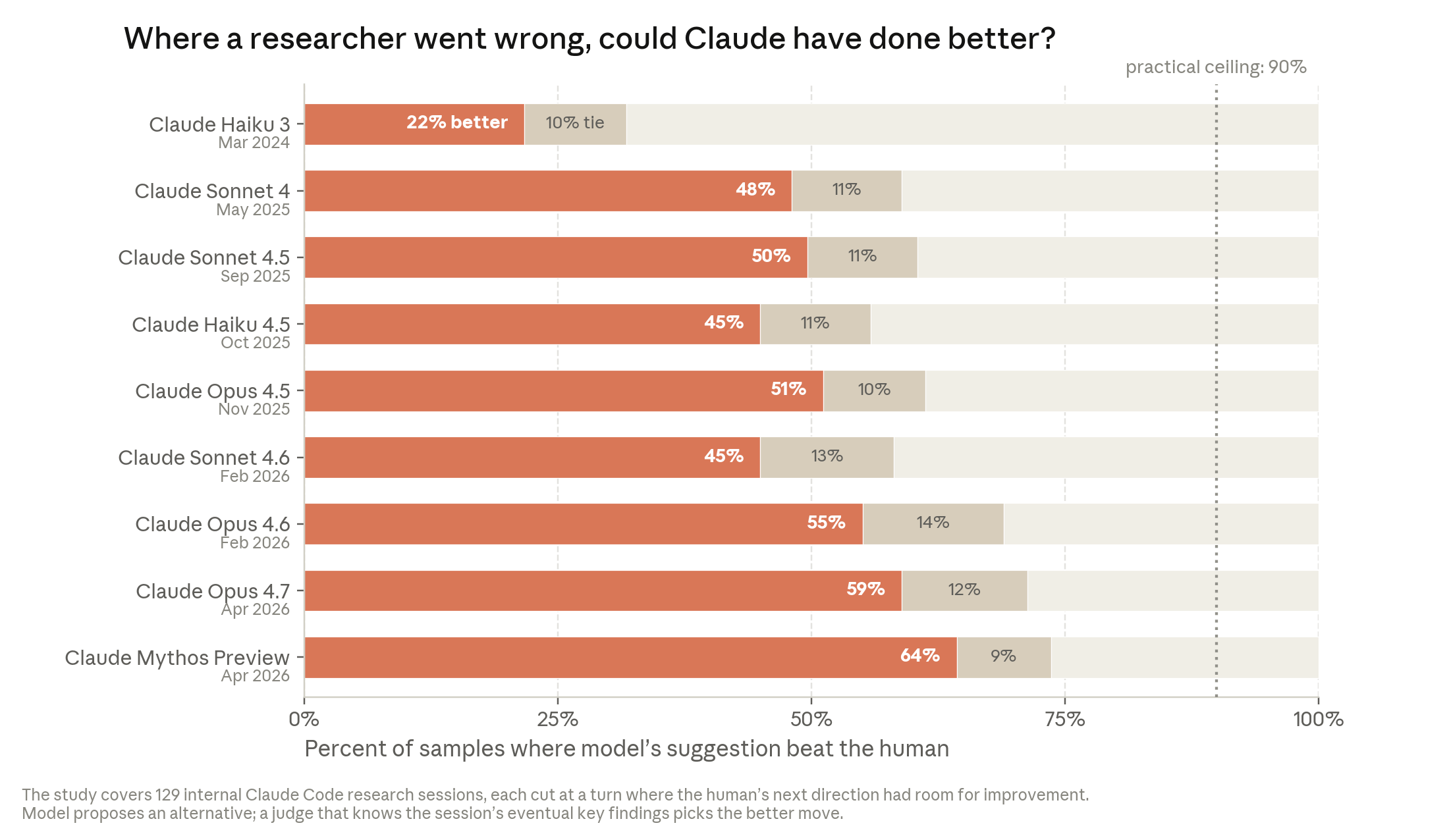
On selected research problems where a human had taken a wrong turn, Claude Mythos Preview suggested a better next step in 64% of cases, compared with 51% for Claude Opus 4.5. This suggests progress in deciding what to try next, beyond carrying out instructions.
Anthropic replayed 129 moments from January–March 2026 research sessions. A separate Claude, shown how each session ended, compared the proposed next step with the human’s original choice. These examples were deliberately selected because the human choice could be improved.
View original chart and methods ↗
When AI builds itself · Evidence from within Anthropic: research-next-step experiment and footnote 8
How to interpret this chart
- The 129 examples were selected because the human next step had room for improvement; this is not a representative comparison with researchers.
- A separate Claude judged proposals using the eventual session outcome. Proposals were not tested by running complete alternative research projects.
- On a separate set of 127 moments where the human choice was already strong, model suggestions were preferred only about 20% of the time. The article does not give a model-by-model breakdown for that check.
- The 90% practical ceiling uses an answer generated with knowledge of the full session. It is a hindsight reference, not an RSI threshold or an ordinary model result.
- The source reports rounded percentages. Model-specific sample counts, confidence intervals, judge version and full task data are not supplied here.
Published values from the chart
Exact printed labels from the original chart, not estimates from bar lengths. Dates identify the models as labeled, not separate evaluation cohorts. All rows concern the same selected 129-session experiment. Ties are not counted as better; no unprinted remainder values have been calculated.
| Model as labeled | Model date on chart | Judged better | Tie |
|---|---|---|---|
| Claude Haiku 3 | March 2024 | 22% | 10% |
| Claude Sonnet 4 | May 2025 | 48% | 11% |
| Claude Sonnet 4.5 | September 2025 | 50% | 11% |
| Claude Haiku 4.5 | October 2025 | 45% | 11% |
| Claude Opus 4.5 | November 2025 | 51% | 10% |
| Claude Sonnet 4.6 | February 2026 | 45% | 13% |
| Claude Opus 4.6 | February 2026 | 55% | 14% |
| Claude Opus 4.7 | April 2026 | 59% | 12% |
| Claude Mythos Preview | April 2026 | 64% | 9% |